DYIP University
DESIGN YOUR INFINITE POSSIBILITIES
DESIGN YOUR INFINITE POSSIBILITIES
The world has changed, but education has not changed enough.
For generations, schools have focused primarily on examinations, textbooks, and memorization. Students spend thousands of hours in classrooms, yet many graduate without understanding the practical skills required for everyday life. They may know mathematical formulas but not how to prepare a budget. They may study biology without growing a single plant. They may learn physics without repairing a bicycle or assembling a machine. They may read about sustainability without ever composting waste, harvesting rainwater, or planting a tree.
At DYIP, we believe education should prepare children not only for a career, but for life itself.
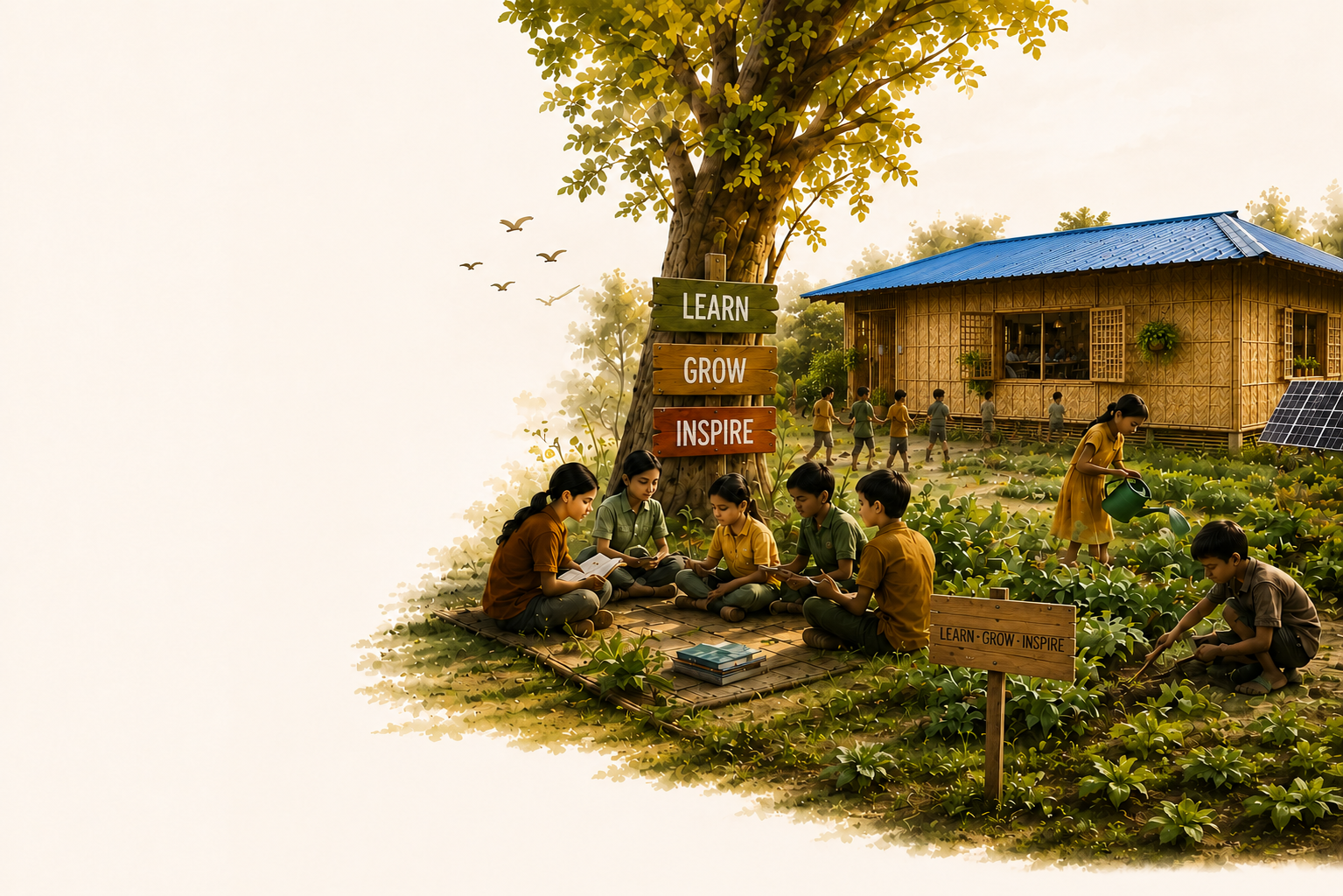
Children are naturally curious. They learn best by observing, experimenting, building, questioning, and creating. Real learning happens when knowledge is connected to experience. A farm becomes a biology laboratory. A workshop becomes an engineering classroom. A kitchen becomes a chemistry laboratory. A forest becomes a living ecology textbook. A community becomes a place to understand economics, leadership, culture, and responsibility.
DYIP (Design Your Infinite Possibilities) was created to build an entirely different learning ecosystem—one where education extends far beyond classroom walls. Here, children learn through meaningful activities that develop knowledge, practical skills, creativity, confidence, emotional intelligence, entrepreneurship, environmental responsibility, and social awareness.
From the age of six to seventeen, students gradually explore hundreds of real-world activities. They grow food, care for animals, build structures from bamboo and mud, design machines, write journals, create art, learn programming, understand finance, practice hospitality, conduct scientific research, and develop businesses. Every activity is connected to real life, allowing students to understand not only what to learn, but why it matters.
There are no examinations that reward memorization. Progress is measured through projects, portfolios, observation, reflection, teamwork, and the ability to apply knowledge in real situations. Every learner develops at their own pace while building a strong foundation of competence and character.
Our vision is simple: by the age of seventeen, every student should leave DYIP not only with academic knowledge, but with the confidence to grow food, solve problems, build useful things, communicate effectively, manage money, work with technology, care for nature, lead communities, and create meaningful livelihoods.
The future does not belong to those who memorize the most. It belongs to those who can learn continuously, adapt confidently, think creatively, and contribute responsibly.
"Education should not prepare children only for examinations. It should prepare them for life."
Education has opened countless opportunities for humanity, but one important question remains: Are we preparing children only to succeed, or are we also teaching them how to face failure?
Every child will experience setbacks in life. An examination may not go well. A business idea may fail. A project may not work as expected. A scientific experiment may produce unexpected results. These experiences are a natural part of learning and growth. Yet many young people are never taught how to manage disappointment, uncertainty, or emotional pressure.
The consequences can be heartbreaking. According to the National Crime Records Bureau (NCRB), India recorded 13,044 student suicides in 2022, with more than 2,200 cases associated with examination failure. Every statistic represents a young life, a family, and dreams left unfulfilled. While every tragedy has multiple contributing factors, these figures remind us that emotional resilience deserves as much attention as academic achievement.
This challenge is not limited to one nation. The World Health Organization (WHO) recognizes suicide as one of the leading causes of death among young people aged 15–29 years, highlighting the importance of building emotional strength alongside intellectual development.
Education should never make a child believe that one examination, one failure, or one difficult phase determines the value of an entire life. True education helps children develop confidence, perseverance, empathy, self-belief, and the courage to begin again after failure.
At the same time, the world is changing rapidly. Artificial Intelligence, climate change, biotechnology, automation, and digital technologies are creating challenges that have no ready-made answers. Information is available everywhere. What truly matters today is the ability to think critically, solve unfamiliar problems, adapt continuously, collaborate with others, and keep learning throughout life.
The future belongs not to those who memorize the most, but to those who can learn, unlearn, rebuild, innovate, and contribute meaningfully to society.
"A child's future should never be decided by a single examination, but by a lifetime of curiosity, resilience, creativity, and continuous learning."
It is often said, "A healthy mind lives in a healthy body." Good education therefore begins with good food. Yet, in many schools, children learn about food from books without ever understanding where it comes from, how it is grown, or the immense effort required to produce it.
At DYIP, we believe that food is one of life's greatest teachers. When a child plants a tiny seed, waters it every day, protects it from insects, waits patiently through changing seasons, and finally harvests it, that child learns lessons that no textbook can fully teach. Food becomes much more than nourishment—it becomes an education in science, patience, responsibility, resilience, gratitude, and wisdom.
Every meal tells a story. Through history, students discover how agriculture shaped civilizations. Through geography, they understand climate, seasons, and local food systems. Through science, they explore soil, microorganisms, biodiversity, nutrition, composting, water cycles, and the effects of chemicals on ecosystems. Through culture, they discover traditions, festivals, recipes, and the identity of communities across generations.
Farming also teaches one of humanity's most valuable qualities—empathy. According to the National Crime Records Bureau (NCRB), 11,290 people engaged in the farming sector (including farmers and agricultural labourers) died by suicide in India during 2022. Behind every statistic is a family facing financial hardship, uncertainty, and emotional loss.
When students experience farming themselves, they understand these realities. They may spend months nurturing crops only to watch them suffer because of drought, floods, pests, or excessive rainfall. They realize that sincere effort does not always guarantee success. This experience develops compassion, emotional resilience, and deep respect for every farmer who feeds society.
Farming also becomes a classroom for economics and financial wisdom. Students naturally learn that not every harvest should be consumed immediately. Seeds must be preserved for future seasons. Money must be saved for uncertain years. Water, tools, fertilizers, and energy must be used carefully. They understand budgeting, planning ahead, avoiding unnecessary waste, and preparing for unforeseen challenges.
Nature wastes nothing. Vegetable scraps become compost. Rainwater is harvested. Seeds are saved. Crop residues return nutrients to the soil. These simple practices introduce children to circular economies, sustainable living, and responsible resource management.
In a world increasingly affected by global warming, climate change, declining biodiversity, and water scarcity, children also learn practical solutions. Organic farming, rainwater harvesting, composting, soil conservation, biodiversity protection, and regenerative agriculture become everyday habits rather than theoretical concepts.
At DYIP, the farm is not separate from the classroom—it is the classroom. Every seed teaches hope. Every harvest teaches gratitude. Every crop failure teaches resilience. Every saved seed teaches planning for the future. Every drop of conserved water teaches responsibility.
"When children learn to grow food, they do not simply learn agriculture—they learn science, economics, empathy, resilience, sustainability, and how to build a better future."
Every civilization, regardless of its history, culture, or technology, has always depended upon two fundamental pillars—Food and Education. Without food, the body cannot survive. Without education, the mind cannot grow. One nourishes the body. The other nourishes the mind. Neither can exist without the other.
A child cannot learn with an empty stomach, and a society cannot progress if it neglects the people who produce its food. Yet, throughout modern development, these two foundations have gradually become disconnected. Education often takes place without understanding agriculture, while agriculture struggles without the support of knowledge, innovation, and public awareness.
At DYIP, we believe these two pillars must once again grow together. That is why we established BHOOMJA FRESH—the natural extension of DYIP's philosophy. While DYIP nurtures minds, BHOOMJA FRESH nurtures the soil. Together they create a complete ecosystem where education and food strengthen one another.
Our mission extends far beyond selling agricultural products. We work to preserve indigenous (desi) seed varieties that have adapted to local climates over generations. We encourage natural and organic farming methods that protect soil health, biodiversity, clean water, and future generations. Farmers receive training, technical guidance, awareness about sustainable agriculture, and practical support to improve both productivity and long-term resilience.
Equally important, we create bridges between farmers and consumers by providing transparent access to naturally grown produce. Healthy food reaches families, while farmers receive fair opportunities to sustain their livelihoods with dignity.
This partnership also transforms education itself. Students at DYIP do not simply study agriculture from books—they experience it. They work alongside farmers, understand the effort required to produce every grain of food, witness the uncertainty caused by droughts, floods, pests, and changing climates, and appreciate the resilience required to begin again after every difficult season.
Farmers become teachers. Their knowledge, experience, patience, and wisdom become part of every student's education.
Students also discover lessons that extend far beyond farming. They learn to preserve seeds for the next season rather than consume everything today. They understand the importance of saving resources for uncertain times. They learn that water should never be wasted, healthy soil must be protected, and every resource has value. They practice budgeting, planning, responsible consumption, and preparing for an unpredictable future.
These lessons build self-reliance. A person who understands how to grow food, conserve resources, solve practical problems, and continue learning throughout life possesses a form of security that cannot be taken away. Such individuals are not limited by circumstance—they are empowered by knowledge, skills, character, and confidence.
Our dream is therefore much larger than producing graduates. We aspire to nurture human beings who are physically healthy, intellectually curious, emotionally resilient, ethically grounded, environmentally responsible, financially wise, and capable of creating meaningful lives.
Whether they become scientists, engineers, artists, teachers, doctors, farmers, entrepreneurs, researchers, innovators, or community leaders is entirely their choice. The purpose of DYIP is not to decide what they should become. The purpose of DYIP is to ensure they possess the knowledge, skills, confidence, and values to become anything they aspire to be, without living in fear, without unnecessary dependence, and with the ability to contribute meaningfully to society wherever life takes them.